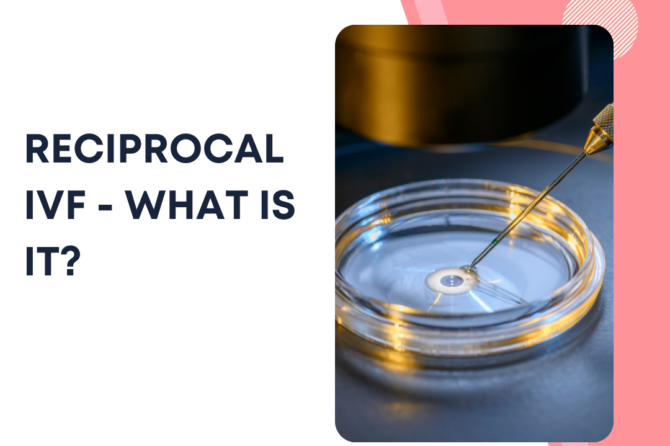
• Reciprocal IVF – what is it?

    Reciprocal IVF – what is it?

    Reciprocal IVF is a revolutionary family-building option designed primarily for lesbian couples, allowing both partners to participate biologically and emotionally in the creation of their child. Here’s a closer look at this process, its role in surrogacy, and its broader implications. What is IVF? IVF (In Vitro Fertilization) is a well-established fertility treatment where eggs are retrieved from the ovaries, fertilized with sperm in a laboratory, and implanted into a uterus. It is used widely to address various infertility challenges. What is Reciprocal IVF? Reciprocal IVF takes traditional IVF a step further by enabling both partners in a same-sex female couple to share in the reproductive journey. One partner provides her eggs, contributing her genetic material, while the other partner carries the pregnancy, creating an unparalleled sense of shared parenthood. Steps in the Reciprocal IVF Process Egg Donation and Ovarian Stimulation: The partner donating eggs undergoes hormonal treatments to stimulate egg production. Once mature, the eggs are retrieved through a minimally invasive procedure. Fertilization: Donor sperm is used to fertilize the retrieved eggs in a laboratory setting, creating embryos. Embryo Transfer: The resulting embryos are transferred to the uterus of the partner who will carry the pregnancy. Hormonal treatments are often administered to prepare her body for implantation and pregnancy. Pregnancy Monitoring: After implantation, the carrying partner is closely monitored to ensure the pregnancy progresses healthily. Reciprocal IVF and Surrogacy In cases where neither partner can carry a pregnancy, reciprocal IVF can be integrated into surrogacy. The embryo created from one partner’s egg and donor sperm can be implanted in a surrogate who will carry the baby to term. This approach offers flexibility for diverse family-building needs, including those involving health concerns or personal preferences. Advantages of Reciprocal IVF Reciprocal IVF offers unique benefits for same-sex female couples, ensuring emotional fulfillment and equal participation in family-building. Here are the detailed advantages: 1. Shared Biological Parenthood Enables one partner to contribute genetically by donating eggs, while the other carries and nurtures the baby during pregnancy. Fosters a deep connection between both partners and the child. 2. Empowering Inclusivity Provides LGBTQIA+ couples a path to biological parenthood that respects and celebrates their identities. Ensures equal participation in creating and raising a family. 3. Personalized Family Dynamics Couples can decide roles based on personal preferences, health considerations, or medical advice. Offers flexibility in how both partners contribute to the process. 4. Emotional Fulfillment Strengthens the emotional bond between partners by involving both in critical roles during conception and pregnancy. Creates shared experiences, making the parenting journey even more meaningful. 5. Legacy Building Provides an opportunity for one partner to pass on their genetic legacy while both partners nurture the child. Establishes a meaningful biological connection to future generations. 6. Adaptability for Surrogacy If neither partner can carry a pregnancy, the fertilized embryos can be transferred to a surrogate, enabling family-building regardless of medical barriers. 7. Advanced Fertility Options Leverages cutting-edge reproductive technology for improved outcomes, increasing the chances of a successful pregnancy. Emotional and Social Benefits Reciprocal IVF is not just about medical science—it’s about creating deeper bonds and redefining family. The process acknowledges the emotional importance of parenthood and ensures inclusivity for couples who might otherwise face barriers to biological reproduction. Why Choose Reciprocal IVF? For Family: It provides an avenue for both partners to experience parenthood uniquely. For Love: Strengthens emotional ties through shared experiences. For Inclusion: Promotes equality in reproductive opportunities for LGBTQIA+ families. Reciprocal IVF is reshaping the way families are built, blending cutting-edge science with the emotional needs of modern families. Whether used independently or as part of a surrogacy journey, it is a testament to how far reproductive medicine has come in fostering diversity and inclusion in parenthood. Contact MediPocket Surrogacy USA for premium Surrogacy service. We make miracles happen and countless intended families are on board with us.

    Read more
  • How do laws protect Surrogacy?

    How do laws protect Surrogacy?

    Surrogacy offers a life-changing path for intended parents worldwide, yet its legal framework is as diverse as the cultures and countries that govern it. Around the globe, surrogacy laws vary significantly, with countries taking diverse stances on commercial, altruistic, and even banned surrogacy practices. This variation often results in complex challenges and uncertainties for intended parents and surrogates alike, and it has led to an ongoing debate on best practices and protections within this deeply personal and medically complex area. In the United States, where surrogacy is primarily regulated at the state level, there is a wide spectrum of legal conditions. Certain states are highly supportive, allowing both commercial and altruistic surrogacy, while others permit surrogacy with restrictions, and a few prohibit it altogether. This lack of federal regulation can make cross-state surrogacy journeys complex but allows many U.S. residents and international intended parents access to a range of choices. Canada’s approach focuses on altruistic surrogacy, making it legal to enter surrogacy agreements but unlawful to pay a surrogate beyond reimbursing certain medical and pregnancy-related expenses. This policy seeks to protect surrogate rights by preventing commercial exploitation while still enabling intended parents to pursue family-building options. The U.K. similarly allows only altruistic surrogacy and requires that surrogates retain parental rights until a transfer of parental responsibility takes place post-birth. Several countries have banned surrogacy altogether, including France and Germany, reflecting concerns around ethical issues and potential exploitation. While these laws are designed to protect women from coercion, they can also limit access to family-building options for citizens and push individuals into international surrogacy arrangements where protections are not always guaranteed. In recent years, there has been a global movement toward establishing more cohesive surrogacy laws to better protect all parties involved. International bodies are advocating for comprehensive frameworks that address ethical concerns, surrogate health, mental well-being, and intended parent rights. Countries like India, which previously had thriving surrogacy industries, have revised laws to enforce stringent surrogate and patient screenings, as well as regulated compensation to ensure that surrogates’ rights and safety are prioritized. With MediPocket Surrogacy USA, international intended parents can navigate these complex legal landscapes. By offering clear guidance on regulatory matters and focusing on transparent, ethical standards, MediPocket ensures surrogacy journeys are safe, legally sound, and compassionate. As surrogacy continues to evolve worldwide, cohesive legal protections and regulatory frameworks are essential to fostering safe, ethical surrogacy practices that protect surrogates, intended parents, and children alike.

    Read more
  • Who Breastfeeds the Surrogate Baby? Understanding the Options for Breastfeeding After Surrogacy

    Who Breastfeeds the Surrogate Baby? Understanding the Options for Breastfeeding After Surrogacy

    Surrogacy is a beautiful journey that brings joy and fulfillment to families who may have struggled to conceive. But once the baby is born, an important question arises: Who breastfeeds the surrogate baby? This is a crucial consideration, as the decision impacts the baby’s health, bonding experience, and overall well-being. While the answer may vary depending on individual circumstances, it’s essential to understand the different options available. Breastfeeding by the Surrogate Mother In some cases, the surrogate mother may choose to breastfeed the baby she carried. This option is more common when there is a close, trusting relationship between the surrogate and the intended parents. Surrogates who decide to breastfeed can provide their milk either directly or through pumping, which is particularly beneficial in the baby’s first few days or weeks. The surrogate’s milk is rich in antibodies and nutrients, offering a strong foundation for the newborn’s immune system and overall health. Breastfeeding by the surrogate can also create a sense of continuity for the baby, as the infant has already formed a bond with the surrogate during pregnancy. However, this option requires clear communication and mutual agreement between all parties involved. Surrogates who choose to continue breastfeeding for an extended period after birth must consider the emotional and logistical aspects of this decision. Breastfeeding by the Intended Mother Another option is for the intended mother to breastfeed the baby. This can be achieved through induced lactation, a process where the intended mother stimulates milk production through hormonal treatments and regular pumping, even if she has not given birth herself. This method allows the intended mother to experience the bonding and health benefits of breastfeeding her child. While induced lactation can be challenging and time-consuming, many intended mothers find it to be a deeply rewarding experience. It enables them to play a direct role in their baby’s nourishment and helps strengthen the emotional bond between mother and child. Support from lactation consultants and healthcare professionals is often crucial for success in induced lactation. Formula Feeding and Donor Milk For some families, formula feeding or using donor breast milk may be the preferred or necessary choice. Formula feeding is a practical and safe option that ensures the baby receives adequate nutrition, especially if breastfeeding is not feasible. Additionally, donor milk from a milk bank or another breastfeeding mother offers a valuable alternative. Donor milk provides the benefits of breast milk when neither the surrogate nor the intended mother can breastfeed. Milk banks carefully screen and pasteurize donor milk to ensure its safety, making it a reliable option for those who wish to provide breast milk to their baby without breastfeeding directly. This approach is particularly useful for babies who have specific nutritional needs or for families where breastfeeding is not an option due to medical or personal reasons. Conclusion The question of who breastfeeds the surrogate baby is complex and personal, with multiple pathways available to meet the baby’s nutritional and emotional needs. Whether through breastfeeding by the surrogate, induced lactation by the intended mother, or formula feeding and donor milk, each option has its benefits and considerations. What matters most is the collaborative effort between the surrogate, intended parents, and healthcare professionals to ensure the baby receives the best possible care from the start. The choice ultimately depends on what works best for the family, taking into account the health, preferences, and circumstances of everyone involved. This decision is part of the larger surrogacy journey, where love, care, and thoughtful planning come together to create a nurturing environment for the newest member of the family. As surrogacy continues to offer hope to many, understanding and discussing feeding options in advance can help families make informed choices that honor their unique situation and bring peace of mind as they welcome their baby into the world.

    Read more

Photostream